
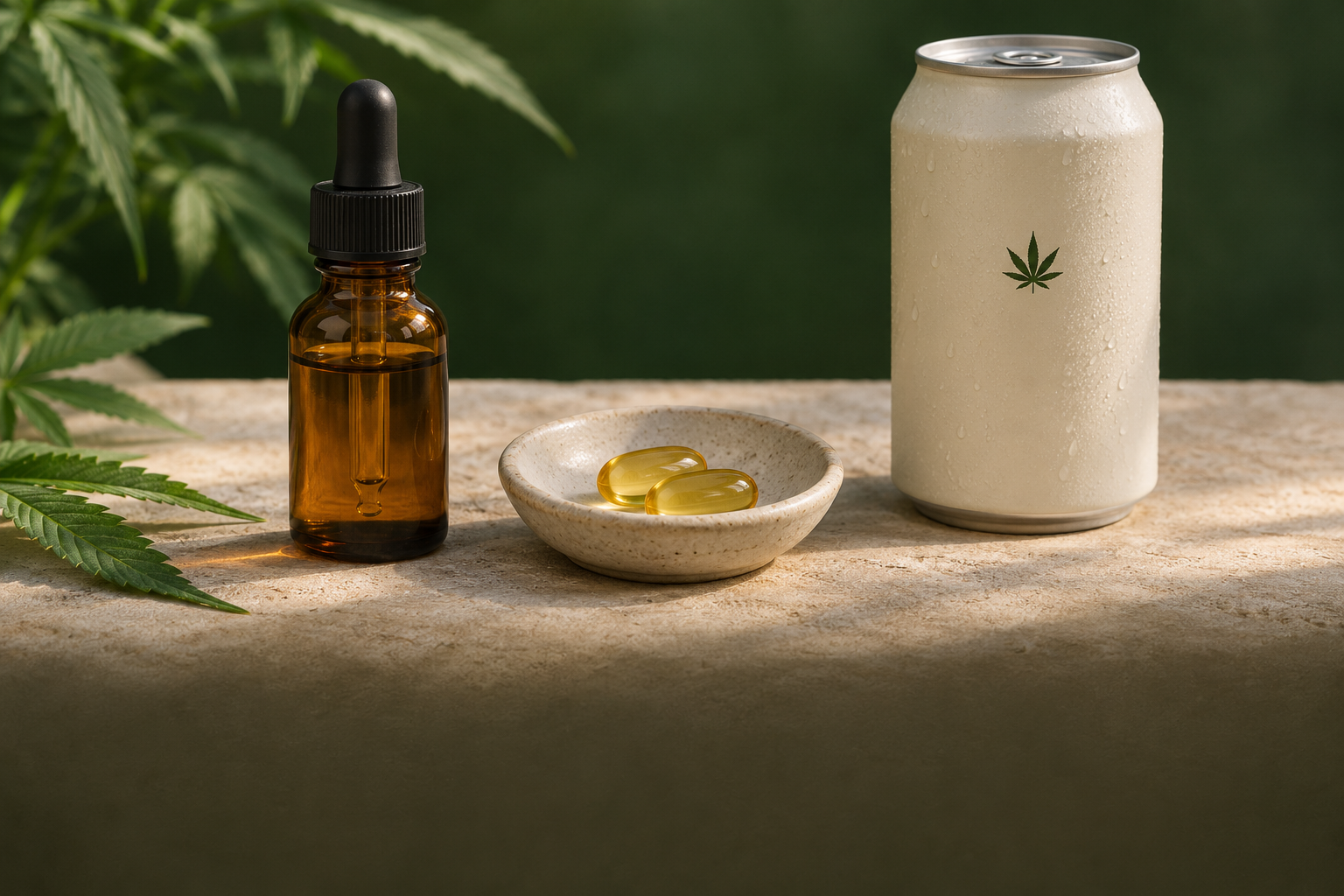
The format changes the timing
Inhaled cannabis enters the bloodstream quickly. When cannabis is swallowed, the digestive system changes the schedule: effects can begin after 30 minutes to two hours and may take up to four hours to reach their full strength. They can last for many hours, sometimes with residual effects the following day.
The timing varies with the formulation, food, and the person. A delayed start is a reason to wait for the full effect before considering more, rather than judging the amount by the first few minutes.
These formats avoid smoke exposure. THC can still cause impairment, and cannabis can interact with medications.
Cannabis oils and tinctures
Cannabis oils are typically cannabis extracts diluted into a carrier oil. Some products are intended to be swallowed, while some oral sprays and tinctures may be used in the mouth according to their product instructions. The route matters: a preparation held in the mouth can behave differently from one swallowed immediately, and effects remain variable.
Look for THC and CBD per millilitre, per activation, or per measured unit, depending on the product. For example, an oil labelled 10 mg THC per mL contains 1 mg in 0.1 mL. The supplied syringe or dispenser makes that measurement possible; an ordinary kitchen spoon is not precise enough.
Cannabis oil is not the same thing as hemp seed cooking oil, which is made from seeds and is not intended to be intoxicating.
Capsules and softgels
A capsule or softgel contains a measured amount of cannabis preparation in a form you swallow. The package should tell you the number of capsules and the THC and CBD amount per unit as well as any relevant totals.
For example, ten capsules labelled 2.5 mg THC each contain 25 mg across the whole package. The per-capsule figure is the useful comparison with another product. Capsules follow the slower timetable of swallowed cannabis, and effects can last for many hours.
A pharmacist or clinician can check medication interactions, including with CBD, if you take prescription or over-the-counter medicines.
Cannabis drinks have their own timetable
Cannabis beverages range from sparkling waters to teas and other flavoured drinks. In Canada they are classified as edible cannabis products.
Some drinks use emulsified formulations designed for faster absorption and may be felt sooner than conventional edibles. Timing still varies by product and person, and the first noticeable effects are not necessarily the full effects. Health Canada advises allowing up to four hours for the full effects of edible cannabis, including drinks, before considering more.
In Canada, edible cannabis products are limited to 10 mg THC per immediate container. A drink with several servings may show a total for the bottle and a separate amount per serving. The total and serving figures belong together when comparing bottles of different sizes.
Keep cannabis beverages clearly separated from ordinary drinks and stored securely away from children and pets.
Compare one measured amount
An edible drink and a bottle of cannabis oil can both show milligram numbers, but they may belong to different legal product classes with different packaging and dispensing rules. Some cannabis extract packages contain much more THC in total than a package of edible cannabis.
For a beverage, look at mg per serving and mg per container. For a softgel, look at mg per capsule. For an oil or spray, find the value per mL or per activation, then use the package's intended measuring method. That lets you compare the amount you intend to use rather than the size of the container.
Bring the comparison together
A useful comparison puts three things side by side: THC and CBD in one measured amount, how the product is intended to be used, and its expected timing. For new or occasional consumers, Health Canada advises starting with 2.5 mg THC or less and waiting for the full effect before considering more.
Avoid mixing cannabis with alcohol or other intoxicants, and never drive impaired. A topical belongs in a separate comparison: it is applied to the skin, rather than swallowed.
Further reading