
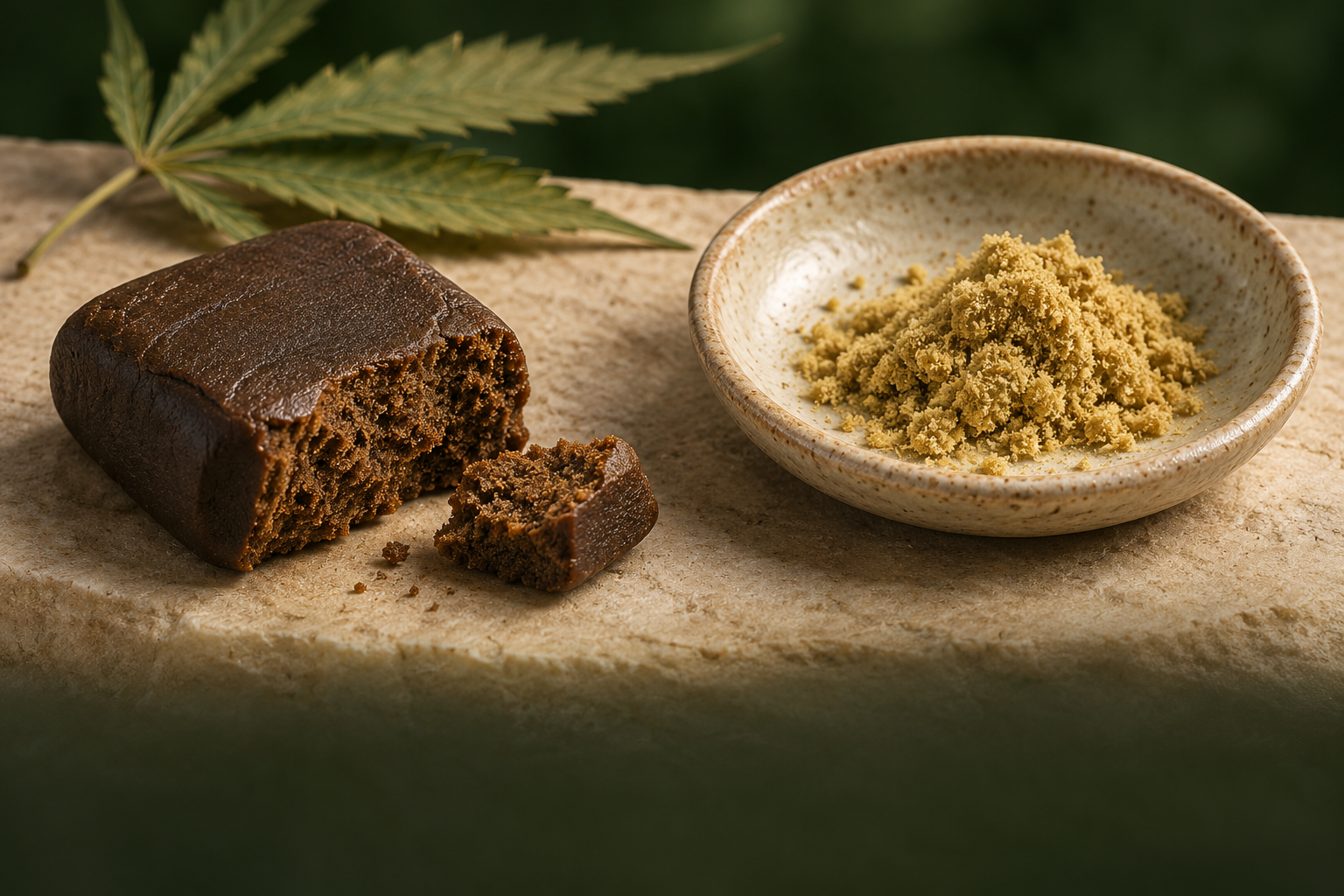
What hash actually is
Cannabis flower is covered in tiny resin-producing structures called trichomes. They contain THC, CBD, and many of the plant's aromatic compounds. Hash, or hashish, is made by collecting and concentrating this resinous material, often pressing it into a block, ball, or softer mass.
Because hash is concentrated, it can contain substantially more THC than ordinary dried flower. In Canada, mechanically separated hash and kief are legally classified as cannabis extracts. That is true even when no chemical solvent is used.
Texture tells you how a hash handles. Total THC tells you its labelled concentration; the two are separate details.
A short tour of traditional hash
Hash has been part of different cannabis traditions in North Africa, the Middle East, and South Asia. Descriptions such as Moroccan, Afghan, Lebanese, and Nepalese usually point to a historical regional style or tradition, not a standard recipe.
Moroccan styles are often associated with sifted resin, while Afghan and Lebanese traditions include different forms of collected and pressed resin. In parts of South Asia, charas traditionally refers to resin collected by rubbing fresh cannabis plants by hand. Nepalese-style temple balls are associated with that hand-worked tradition.
On an Ontario menu, these names often describe a style. A Canadian producer can make Moroccan-style hash, for example. The producer's description can explain how closely the method follows the tradition.
Dry sift, bubble hash, and modern labels
Dry sift is resin material separated from dried cannabis using screens or other mechanical methods. It may appear as a loose powder, a granular concentrate, or material pressed into hash.
Bubble hash, also called ice-water hash, uses cold water and filtration to separate trichomes. Depending on the starting material and processing, the final product can vary considerably in appearance and texture.
Full melt describes hash that melts with very little solid residue when heated. You may also see a star scale, with six-star generally used for the highest melt quality. These are industry descriptions, so grading can differ between producers. For equipment compatibility, use the product's own instructions.
Hash, kief, rosin, and hash oil are different
Kief usually refers to loose, separated trichomes. Hash describes a concentrated trichome product that may be pressed or otherwise collected. Rosin is a different extract made using heat and pressure; it may start with flower, sift, or hash.
Hash oil is a broad name for concentrated extracted cannabis resin, often in a thick, viscous form. It is different from the diluted, carrier-oil products sold for oral use. Live resin is another extract, generally made from freshly frozen cannabis.
In retail language, solventless means no chemical extraction solvents were added. Hash and rosin can still have high THC concentrations.
Colour, texture, and the package
Traditional descriptions often focus on whether hash is blond, brown, red, black, crumbly, or soft. These characteristics are part of what makes one style distinct from another. Processing, plant material, and storage can all affect appearance; colour alone cannot establish potency or purity.
Alongside those physical details, compare the producer, product type, ingredients where listed, and Total THC and Total CBD. For an extract labelled 400 mg/g Total THC, that is approximately 40% THC by weight. A figure in mg per package instead gives the total amount in the container.
Keep hash sealed in its original child-resistant packaging, away from heat and out of reach of children and pets.
Further reading