Names for the plant
Weed, pot, grass, herb, green: Everyday names for cannabis. Grass may sound more familiar to someone who remembers the '70s; weed has proved remarkably durable. None identifies a particular variety or strength.
Bud / nug: A piece of cannabis flower. Nug is short for nugget. When a menu says smalls or popcorn, it usually means smaller buds rather than a different kind of plant.
Reefer / Mary Jane: Older names for cannabis. Reefer can also mean a joint. You will hear both in music, films, and deliberately old-fashioned conversation.
Dope: A familiar word for cannabis in some Canadian conversations, but a much broader word for drugs elsewhere. Context matters with this one.
For the formal menu vocabulary, including cultivars, cannabinoids, and terpenes, there is also the modern cannabis dictionary.
Joints, doobies, and other rolled things
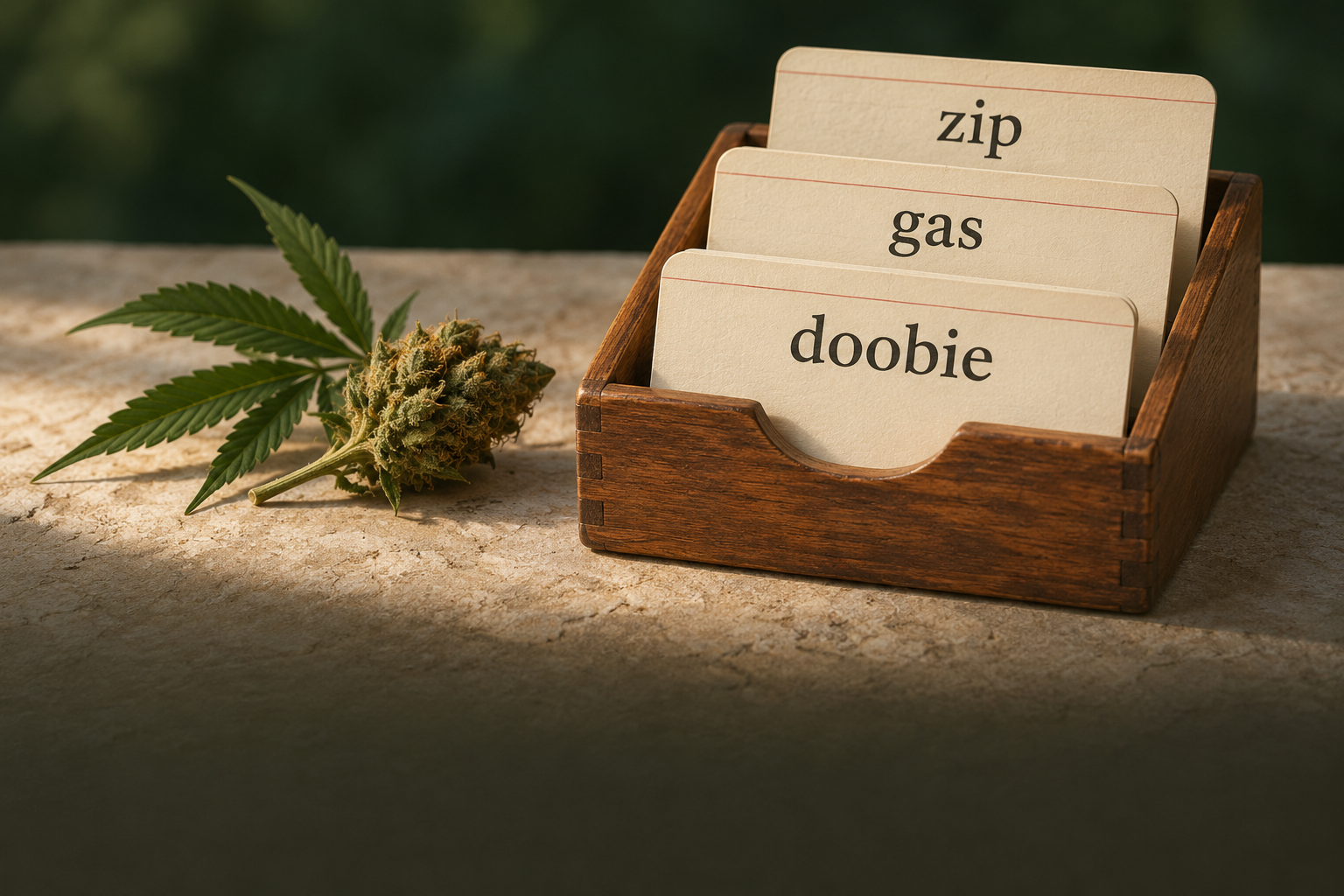
Joint / J / jay / doobie / doob: Names for cannabis rolled in paper. A pre-roll is one already prepared for sale. The nickname alone does not tell you whether it contains flower only or has an extract added.
Pinner / fatty: A thin joint and a thick one, respectively. These describe size, with no agreed weight attached. A dogwalker usually means a short, small joint; the name is a joke about its length, not a special recipe.
Spliff: Often a cannabis-and-tobacco joint in North American and European usage. In Jamaica and some other contexts, it can simply mean a cannabis joint. If the ingredients matter to you, the word alone will not settle the question.
Blunt: Traditionally cannabis in a cigar or tobacco-leaf wrap. Canadian shops also use the word for products with hemp or other tobacco-free wraps. The package ingredients tell you which version you are looking at.
Roach: Usually the small end left after a joint has been smoked. In British usage, it can also mean the rolled-card mouthpiece, even before the joint is lit.
The language of a rave review
Fire / chronic: Praise for cannabis someone thinks is particularly good. Chronic can also be a cultivar name. In casual conversation, neither word supplies a measurable grade.
Dank / loud: Usually compliments suggesting a pronounced aroma, desirable flower, or both. Loud is the smell metaphor: this one announces itself. Despite the ordinary meaning of dank, the compliment is not a recommendation for damp cannabis.
Gas / gassy: Can describe a fuel-like or diesel-like aroma. “That is gas” can also be general praise, without a literal fuel smell. Those are two different pieces of information.
Zaza / za / exotic: Slang for flower presented as unusual, sought-after, or especially good. The terms travel through music and social media, and what counts as exotic changes with the speaker.
Mids / schwag: Mids suggests ordinary or middling flower and is often used dismissively. Schwag is a stronger put-down for poor-quality cannabis. These are opinions, not Canadian retail classifications.
“Loud and gassy” gives you a clue about the description. “I liked its peppery smell and the way it felt to me” tells you more about the person's actual experience.
Eighths, half-quarters, and zips
An eighth / a half-quarter: An eighth of an ounce, conventionally sold as 3.5 g. Half-quarter is a term you may hear in Canada: half of a quarter-ounce. Different arithmetic, same familiar package size.
A quarter / a half: Usually a quarter-ounce or half-ounce of flower, conventionally 7 g or 14 g. The missing word is ounce, not gram.
An ounce / an O / a zip: An ounce of flower, usually a 28 g retail package. The precise ounce is about 28.35 g; cannabis menus commonly use the rounded sizes above.
A dime bag / a nickel bag: Older price-based names for ten dollars' or five dollars' worth. They never gave you a dependable gram amount. They are more useful for understanding an old story than comparing today's packages.
Carts, dabs, and the newer shorthand
Cart: Short for vape cartridge. A 510 cart fits a compatible 510-thread battery. A cartridge and the battery that powers it are separate parts.
Pen: Usually a pen-shaped vaporizer. People use it loosely for a cartridge-and-battery setup, an all-in-one vape, or a device for concentrates. “I need a pen” can therefore mean several different things at the counter.
Dab / dabs: A small amount of cannabis concentrate, or concentrates collectively. Small describes the physical amount, not a standard THC dose. A rig is equipment associated with vaporizing those concentrates.
420 / 710: Cultural shorthand. 420 is associated with cannabis generally, including April 20. 710 is associated with oils and concentrates: turn the digits upside down and they resemble OIL. July 10 carries the same reference.
The conversation around cannabis
Sesh / stash: Sesh is short for session, often a social occasion involving cannabis. A stash is someone's supply. Neither refers to a particular product.
Bogart: To keep something to yourself instead of sharing it, especially a joint. The word has escaped cannabis conversations too; people can bogart the remote or the snacks.
Buzzed / high / stoned / baked: Informal descriptions of intoxication. Speakers often use them to suggest different degrees or kinds of experience, but there is no shared scale. One person's “a little baked” tells you very little about someone else's response.
Couch-lock / munchies: Couch-lock describes feeling settled in and reluctant to move. The munchies means a strong appetite associated with cannabis. Both describe experiences people report, rather than effects a cultivar name can promise.
Greening out: Slang for feeling unwell after too much cannabis, often with nausea, dizziness, or anxiety. It describes an unpleasant reaction, rather than just another word for being high.
Further reading
Check the source.
Slang has overlapping meanings, and these references will not agree on every word. That is part of the language, particularly when a term crosses a border or a generation.